Gym Trading Environment
QTrade ships a Gymnasium environment
(qtrade.env.TradingEnv) that wraps the same Broker as
Backtest. The agent steps through bars one at a time; same accounting,
fill semantics, SL/TP behavior — just driven by step() instead of a
Python loop.
For customizing the action / observation / reward, see Customizing Trading Environment.
Initializing
import yfinance as yf
from qtrade.env import TradingEnv
from qtrade.core.commission import PercentageCommission

data = yf.download(
    "GC=F",
    start="2022-01-01",
    end="2024-01-01",
    interval="1d",
    multi_level_index=False,
)

# Indicators added to the DataFrame become observable features by default.
data['Rsi'] = data['Close'].pct_change().rolling(14).mean()  # placeholder for ta.rsi
data['Diff'] = data['Close'].diff()
data.dropna(inplace=True)

env = TradingEnv(
    data=data,
    cash=3000,
    commission=PercentageCommission(0.001),
    window_size=10,        # observation lookback (also defines warmup)
    max_steps=400,         # max bars per episode
    random_start=False,    # start at index `window_size`
    trade_on_close=True,   # market orders fill at current bar's close
)
The default ObserverScheme returns a (window_size, n_features)
window of every column except OHLCV. So the indicators you add to the
DataFrame become the observation features automatically.
The step API
env.step(action) returns the standard 5-tuple:
obs, reward, terminated, truncated, info = env.step(action)
Field |
Meaning |
|---|---|
|
Whatever the |
|
|
|
|
|
|
|
Dict (see below). |
When either terminated or truncated becomes True, the broker calls
close_all_positions() automatically — the episode is “settled” before
returning.
What’s in info?
Every step:
Key |
Meaning |
|---|---|
|
|
|
|
|
|
|
Net signed |
|
Count of closed trades so far this episode. |
|
Sum of |
|
Mean |
|
|
If you need additional fields (open trade count, drawdown so far,
specific trade properties), subclass TradingEnv and override step
to extend the dict.
Episodes: terminated vs truncated
The Gymnasium convention is:
terminated: the episode reached a natural end (won, lost, or ran out of valid states).truncated: the episode was cut by an artificial time limit.
In TradingEnv:
terminatedfires when there’s no more data (current_step == len(data) - 1). The episode is “complete.”truncatedfires whenmax_stepsis reached. The episode could have continued but you set a budget.
stable-baselines3’s value bootstrapping treats them differently —
make sure you set max_steps short enough that most episodes truncate
(so the agent learns from many short episodes), but not so short that
the strategy never has time to play out.
random_start for episode diversity
By default random_start=False: every episode starts at bar index
window_size. With random_start=True, each reset() picks a random
start in [window_size, len(data) - max_steps), so episodes sample
different market regimes.
Required: len(data) > window_size + max_steps. The constructor
raises a clear ValueError if not — keep max_steps < len(data) - window_size to leave room.
A typical training loop
from stable_baselines3 import PPO

model = PPO("MlpPolicy", env, verbose=1)
model.learn(total_timesteps=200_000)

obs, _ = env.reset(seed=42)
for _ in range(400):
    action, _ = model.predict(obs, deterministic=True)
    obs, reward, terminated, truncated, info = env.step(action)
    if terminated or truncated:
        break

env.show_stats()
env.plot()
env.show_stats() and env.plot() work the same as on a Backtest
instance — same metrics, same multi-panel Bokeh report — because they
both delegate to the underlying Broker.
Rendering
env.render('human') opens a live mplfinance candle chart updating
every step:
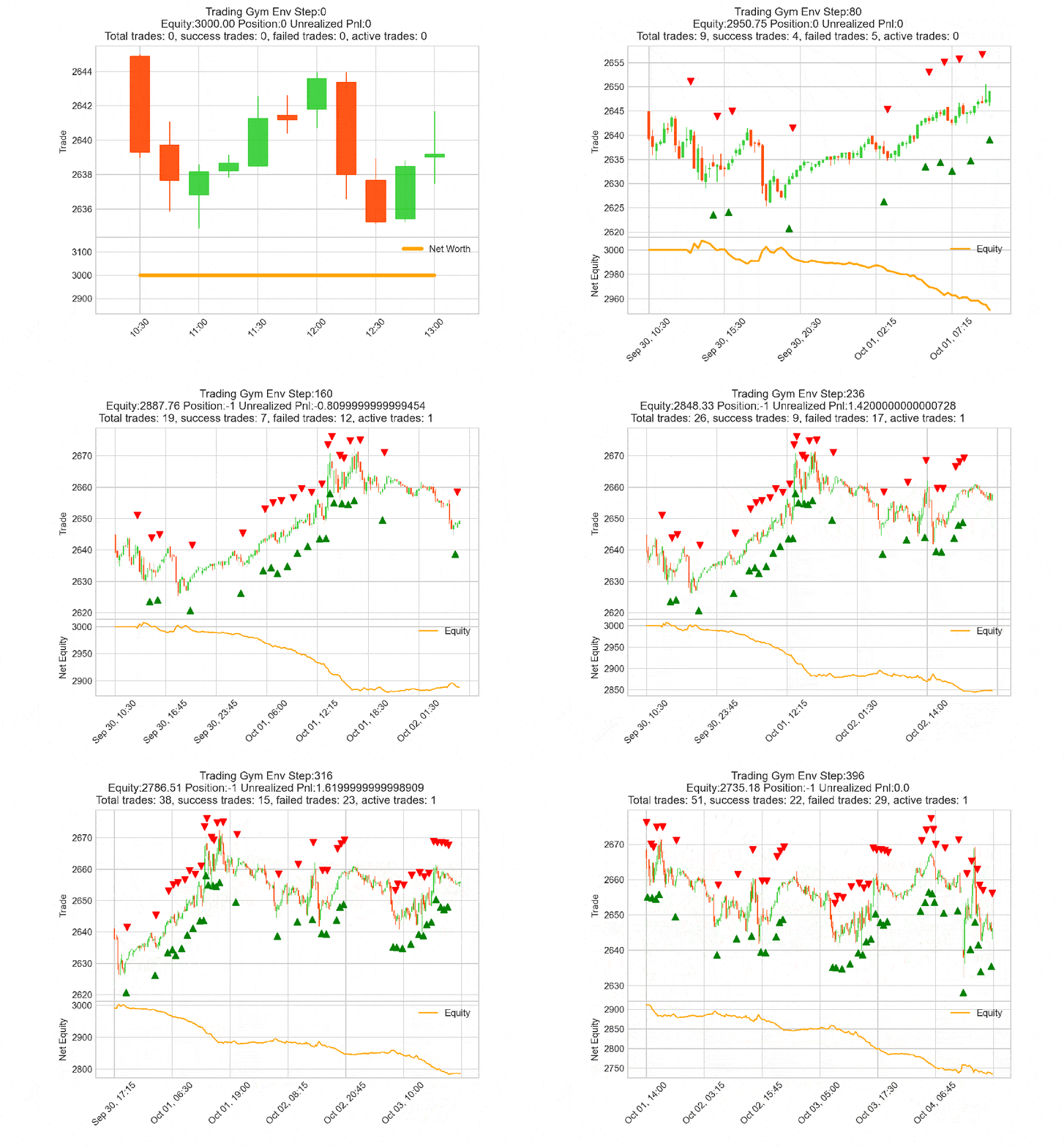
For RGB array output (e.g. SB3’s VecVideoRecorder):
env = TradingEnv(..., render_mode='rgb_array')
frame = env.render()  # → ndarray of shape (h, w, 3)
Heads up: rendering is slow. For training, leave it off (
render_mode='human'is the default but you don’t have to callrender()) and only render during evaluation.
Common pitfalls
Sparse reward: the default reward only fires on bars where a trade closes. Long episodes with no closures train poorly. Either use an equity-based reward (see Customizing Trading Environment) or shorten episodes so end-of-episode auto-closure provides regular signal.
Indicators with NaN at start: any column you add to
datais observed as-is. NaN in the observation crashes most policies. Drop the warmup rows withdata.dropna(inplace=True)after computing indicators.Action / observation drift: if you change schemes mid-experiment and load an old model, you’ll get shape mismatches. Save model and scheme together when you’re going to load.